
2026 Outlook for Corporate Citizenship and Philanthropy: What It Means for Nonprofits and Corporate Giving
In a recent report by the The Conference Board, corporate citizenship leaders shared insights into how companies are approaching philanthropy, nonprofit partnerships, and social impact initiatives in 2026. The research—authored by Matteo Tonello and Andrew Jones—reveals a shifting landscape where companies are becoming more strategic about charitable giving, nonprofit partnerships, and resource allocation.
For nonprofit organizations and socially responsible companies alike, these changes present both challenges and opportunities. Strong financial management, strategic planning, and transparency are becoming essential for organizations hoping to secure and maintain corporate support.
At MMR CPA, we help nonprofits and mission-driven organizations build the financial systems, reporting capabilities, and strategic insights needed to thrive in this evolving environment.
Corporate Philanthropy Budgets Are Stable — But More Strategic
The report indicates that corporate citizenship budgets entering 2026 are largely stable, but companies are becoming more selective in how they allocate funds.
Key trends include:
- More investment in employee volunteering programs
- Possible reductions in cash grantmaking and sponsorships
- Greater scrutiny on the business impact of philanthropic initiatives
More than half of surveyed corporate leaders expect to increase resources toward employee volunteering and community engagement programs, while fewer anticipate expanding direct grant funding.
This shift means nonprofits must demonstrate:
- Measurable impact
- Strong financial stewardship
- Clear alignment with corporate partners’ goals
Organizations that can present clear financial reporting and measurable outcomes are far more likely to attract and retain corporate support.
New Tax Policy Is Influencing Corporate Giving Strategies
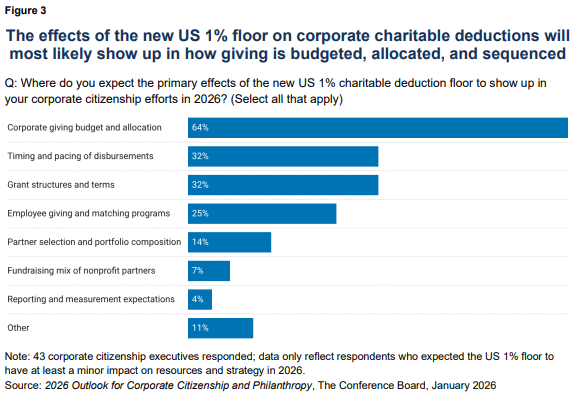
Another major factor shaping philanthropy in 2026 is a change to U.S. tax law. Corporations can still deduct charitable contributions up to 10% of taxable income, but only donations above 1% of taxable income are now deductible.
As a result, many companies are:
- Tightening their giving portfolios
- Carefully timing philanthropic disbursements
- Using multiyear grants to manage deductibility
- Reassessing the balance between corporate and foundation giving
For nonprofits, this means competition for corporate grants may increase, making financial credibility and operational efficiency even more critical.
This is where strong nonprofit accounting and financial strategy become essential.
Corporate Giving Is Shifting Toward Economic and Community Needs
Companies are also narrowing their philanthropic priorities toward widely shared economic concerns.
In 2026, the most supported initiatives include:
- Food security programs
- Housing and affordability initiatives
- Digital inclusion and AI literacy
- Workforce and economic participation programs
These themes align closely with community stability and workforce development, making them attractive areas for corporate partnerships.
Nonprofits operating in these sectors may see greater opportunities for collaboration, especially if they can demonstrate strong governance, financial transparency, and measurable results.
Nonprofit Financial Stability Is Becoming a Major Concern
The survey also highlights a critical issue: nonprofit fragility.
Only 15% of corporate citizenship leaders consider their nonprofit partners financially stable, with many attributing instability to reduced federal funding and rising operational costs.
For nonprofits, this underscores the growing importance of:
- Accurate financial reporting
- Strategic budgeting and forecasting
- Strong governance and compliance
- Professional accounting oversight
Organizations with solid financial infrastructure are far more likely to gain the trust of corporate donors and partners.
Why Financial Leadership Matters More Than Ever
As corporate philanthropy becomes more strategic and scrutinized, nonprofits must operate with greater financial discipline and transparency.
At MMR CPA, we specialize in helping nonprofits and mission-driven organizations strengthen their financial operations through:
- Nonprofit bookkeeping and accounting
- CFO advisory services
- Financial strategy and reporting
- Compliance and audit preparation
- Budgeting and financial planning
Our goal is to help organizations build the financial credibility needed to attract donors, secure grants, and sustain long-term impact.
Position Your Organization for Funding and Growth
The philanthropic landscape is evolving. Organizations that prioritize financial transparency, strategic planning, and operational efficiency will be best positioned to benefit from corporate partnerships in 2026 and beyond.
If your nonprofit or mission-driven organization wants to strengthen its financial foundation and attract more funding opportunities, our team is here to help.
👉 Book a consultation with our nonprofit financial experts:
MMR CPA